Had a gorgeous bus ride along the Circuito Sur coastline towards Cienfuegos. Wandered through this much bigger city (that had belonged to the French) and settled along the malecón (promenade) for shrimps at sunset. Such lovely hosts once again, they invited us to eat dinner with them on the day of the fish market (it seems that kids move out and Cuban parents start guesthouses). With me translating, we had a really interesting chat about the consequences of the Revolution and how the State functions now. They also recommended we visit the Benny Moré centre, where we watched a local guitar trio wow the crowds under the name of the local musical legend.
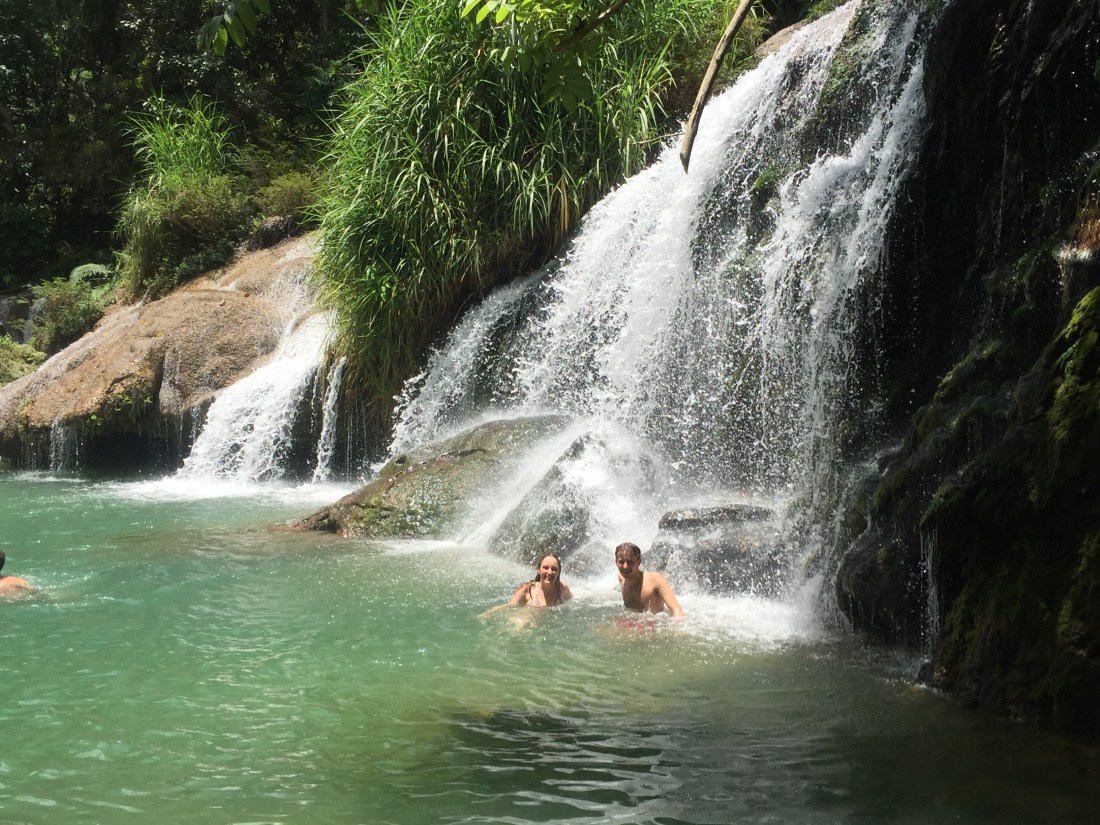
We grabbed a colectivo (this one was a blue vintage American car) to the green mountains of the Sierra de Escambray, where a lot of fighting happened during the Revolution. We headed to the national park called El Nicho via the Cumanayagua road, whose curves inspire a fair few chat up lines. We found ourselves in a series of stunning waterfalls and natural pools that were incredibly fresh (see us grinning). Afterwards we took the woody trails through to the huge waterfall that crashed into the rocks at incredible speed, and another natural pool near a stunning viewpoint. Back in town, we wandered through a tourist artisan market that is now deserted thanks to Trump’s recent ban on US cruise ships stopping at Cuba (coastal Cienfuegos was a definite hotspot).
Another day we had an eventful journey on the commuter ferry across to Jagua, bearing in mind that it’s been averaging 36 degrees. No word of a lie, there were about 200 people crushed into this small boat for the 40 minute trip across the bay. Needless to say, we were both hot and rather bothered. Enduring that journey ended up being worth it as we marvelled at the view from the castle, an old Spanish fortress, and had a brilliant guide to explain the various stages of its history. Although sadly, due to Trump’s travel ban, the castle and museum were completely empty. At one point, the Soviet Union decided to start building a nuclear power plant nearby, which meant thousands of men and women travelled from all over Cuba for work. When the Soviets left Cuba, they thus left behind thousands of people stuck on this small outcrop of land, who had to find alternative methods of employment, much of which was fishing.
The Cuban diet consists mainly of meat/fish with rice (which is grown here with the help of Vietnamese residents). Vegetables, especially fresh ones, are few and far between. However a cafe on the main square served a cracking tuna salad which I ate every day we were here, to sort out my vegetable fix! Also, another culinary treat was Coppelia, the ice cream cafe which was buzzing all day and night as the locals ordered bowl after bowl of the day’s flavour.

 holahola2019